
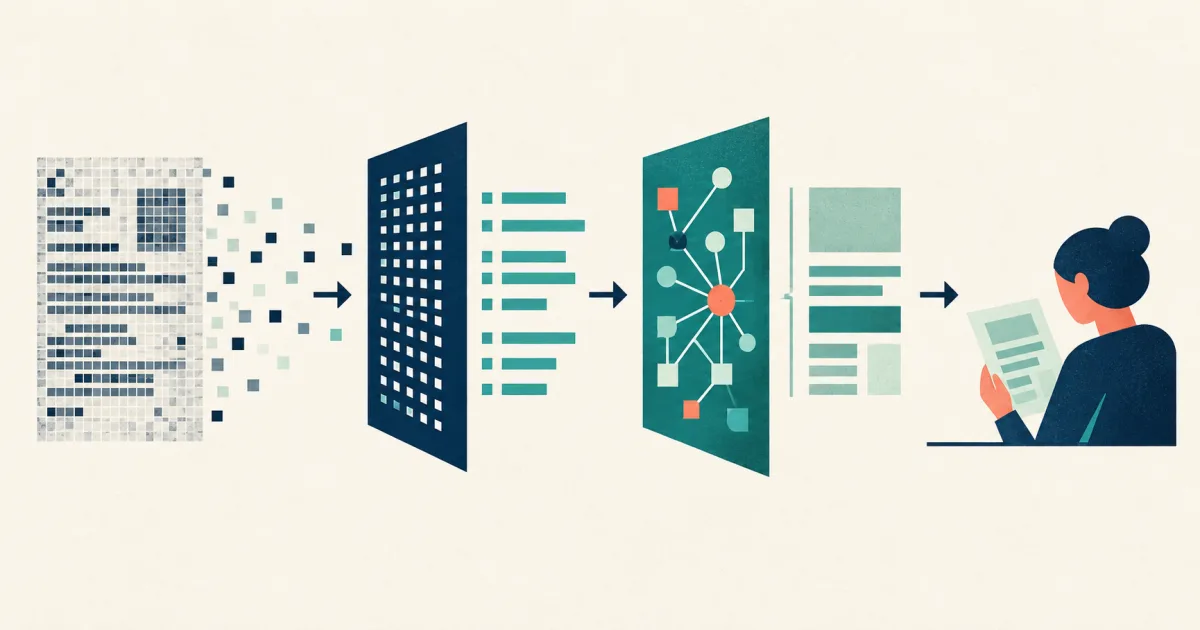
OCR is a recognition task, not one single kind of technology. Older systems matched shapes and rules. Modern systems may use machine learning to detect text, read characters, recover layout, or predict document fields. Calling every OCR result “AI” hides the practical question: what did the system infer, and what must a person still verify?
The short answer
Optical character recognition converts visible characters in an image into machine-readable text. A basic OCR engine can perform that task without a generative language model. A document AI system usually adds learned models for layout, handwriting, language detection, field extraction, or reading order. Both can be wrong, and neither turns a scan into verified truth.
Four layers that people often call OCR
- Image preparation: Rotation, contrast, resizing, and noise removal make character edges easier to inspect.
- Text detection: The system decides which parts of the page contain text and how those regions are grouped.
- Character recognition: Pixels are mapped to letters, numbers, punctuation, or symbols.
- Document interpretation: A more advanced system may label a total, supplier, table row, heading, or address.
The first three layers can exist in traditional OCR software. The fourth is commonly associated with document AI because it assigns meaning or structure to the recognized text. Free-OCR.net separates the primary text from local review signals in its OCR methodology so the returned text is not confused with proof of accuracy.
Where machine learning helps
Learned models can handle wider variation than a fixed character template. They may recognize several fonts, mixed page layouts, natural photographs, or English and Chinese on the same page. They can also preserve headings or tables more usefully than a flat character stream.
That flexibility creates a different failure mode. A model can produce text that looks fluent even when the source is faint or ambiguous. A clean sentence is not automatically a faithful transcription. The most dangerous errors are often plausible substitutions: a date that still looks like a date, a total that still looks like a total, or a name that resembles a familiar name.
OCR is not the same as generative AI
Generative AI predicts an output from learned patterns and instructions. OCR is constrained by visible source evidence, even when the recognition engine uses neural networks. A good transcription workflow tells the engine not to summarize, translate, correct, or fill gaps. The source remains the authority.
This distinction matters when you use the image-to-text OCR tool. The extracted text is useful for searching, copying, or drafting. It should not silently replace the image when the exact wording has financial, legal, medical, academic, or identity consequences.
A practical trust test
Before relying on a result, ask three questions:
- Can I compare the output with the original image?
- Does the interface expose page boundaries, word positions, confidence, or another review signal?
- Will a person check the fields that could change a decision?
If the answer is no, the system may still save typing time, but it is not a safe verification process. Confidence can help prioritize review, yet a high score does not prove a word is correct.
Choose the system by the document problem
A clear printed page may need only ordinary OCR. A bilingual document benefits from script-aware recognition. An invoice needs field and line-item review. A handwritten instruction needs ambiguity markers rather than confident guessing. A searchable PDF needs aligned word positions as well as text.
The label “AI OCR” is therefore less useful than a description of the source, output, and review contract. Start with the document you have, identify what must survive extraction, then choose the smallest workflow that produces a checkable result.
Bottom line
OCR may use AI, but OCR and AI are not interchangeable terms. The meaningful difference is whether the system only recognizes characters or also interprets language and document structure. In both cases, keep the source, inspect consequential fields, and treat recognition as evidence to review rather than a fact to accept.
How this article was prepared
This article entered through a domain-matched editorial queue. Before scheduling, automated safeguards check OCR topic fit, structure, duplicate similarity, link labels, and image requirements, then place approved work on the weekly publishing calendar. Automated checks cannot prove that every factual claim is correct. Check consequential facts against primary sources and use the editorial policy to report a correction.