
Shape
Distinguish similar symbols such as a letter, digit, operator, or Greek character.
Formula OCR converts visible mathematical notation into editable LaTeX and Markdown math. It preserves symbols rather than solving the expression, so verify superscripts, subscripts, fraction boundaries, roots, matrices, and ambiguous handwritten marks.
The tool transcribes notation and does not solve it. Check superscripts, subscripts, grouped expressions, matrix boundaries, and similar-looking symbols before reuse.
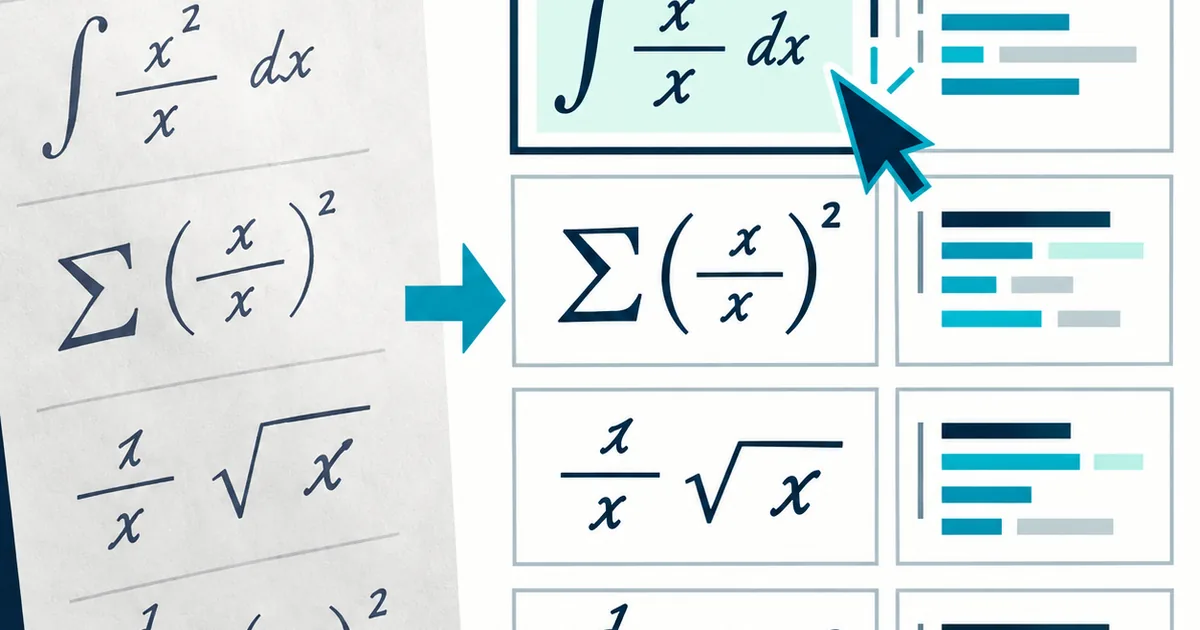
Mathematical OCR has to distinguish position as well as shape. A small shift can turn an index into an ordinary character or change which terms belong inside a fraction, root, or matrix.
Use this route for one focused equation or a compact formula block that needs reusable math code. The output is a code draft. Mathematical correctness and the truth of the expression remain separate questions.
Distinguish similar symbols such as a letter, digit, operator, or Greek character.
Preserve indices, limits, accents, and aligned lines because vertical placement carries meaning.
Check which terms belong inside each fraction, radical, bracket, case, or matrix.
A tight but complete crop reduces competing text while protecting the strokes that define fractions, radicals, brackets, and multiline alignment.
Remove surrounding prose, page numbers, and unrelated diagrams. Keep enough margin to preserve fraction bars, root strokes, matrix brackets, and equation labels.
Do not flatten a low-resolution image until superscripts and subscripts touch the main line. Their position carries meaning even when the character shape is clear.
Confirm braces, parentheses, fraction boundaries, radicals, and matrix rows first. A correct symbol inside the wrong group still changes the expression.
Paste the result into the Markdown or LaTeX environment where it will be used. Package support and delimiter rules differ between editors.
Start with the large structure, then move inward. This catches errors that a symbol-by-symbol reading can miss.
For handwritten sources, start with How Handwriting OCR Works, Fails, and Needs Review.
For capture quality and careful transcription decisions, use the formula capture and recognition accuracy guides.
Printed equations, textbook notation, presentation formulas, and clean digital captures.
Solving equations, proving correctness, or interpreting diagrams and surrounding scientific prose.
Subscripts, superscripts, limits, fraction scope, root bars, matrix boundaries, and similar symbols.
Copy LaTeX for a TeX document or use Markdown math in a compatible editor. Keep the source image beside the code until grouping, indices, limits, and symbol choices have been rendered and checked.
No. The tool transcribes the notation that is visible. It does not calculate, simplify, prove, or validate the mathematical statement. Read the recognition methodology.
Clear separated symbols may produce a useful draft, but connected handwriting and personal notation need close source comparison. Understand handwriting limits.