
Stable block letters
Separated characters and consistent spacing give the strongest starting point.
Handwriting OCR can create a useful first draft from neat notes, block letters, and well-spaced forms. Personal letter shapes and connected cursive remain ambiguous, so every name, number, date, dosage, and instruction must be checked against the image.
Treat every result as a draft. Verify names, numbers, dates, quantities, negations, and any word with more than one plausible reading.
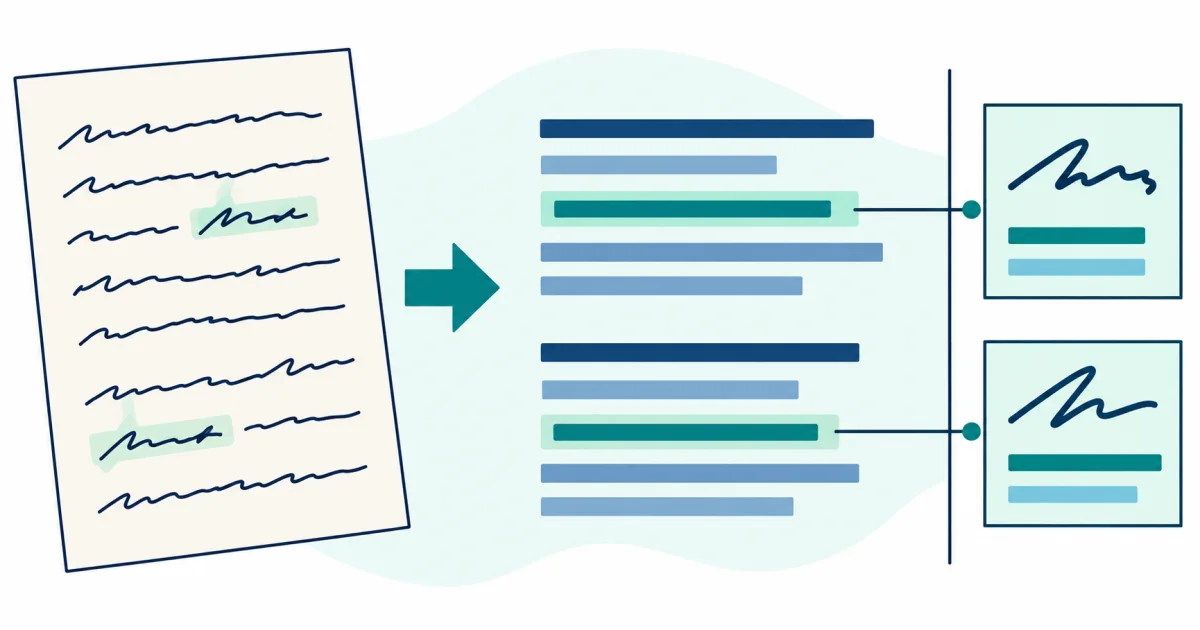
Printed text repeats stable shapes. Handwriting changes with the writer, speed, pen, and neighboring letters, so the editor keeps the source-to-text review step visible.
Use handwriting OCR to reduce typing, not to replace human verification of ambiguous writing. Recognition saves typing time only when uncertainty remains visible and a person can compare the draft with the page.
Separated characters and consistent spacing give the strongest starting point.
Shared strokes can support several plausible character boundaries.
Numbers, dates, names, and instructions require direct source review.
Start with meaning-changing fields, then read sentence context, and leave unreadable text visibly unresolved.
Keep the camera parallel and remove shadows that cross individual strokes.
Avoid tight crops that remove ascenders, descenders, margins, or context from neighboring words.
Use a bracket or placeholder when the source cannot support one reliable reading.
Check dates, quantities, addresses, medication names, and instructions before ordinary prose.
Do not silently correct grammar, spelling, or abbreviations because transcription should remain distinct from later editorial changes.
Dense cursive, damaged originals, unfamiliar abbreviations, and formal records may need a trained reviewer rather than another OCR pass. Read How Handwriting OCR Works, Fails, and Needs Review.
For a realistic human-review boundary, use the handwriting and transcription decision guides.
Neat notes, block lettering, labeled forms, and clearly separated handwritten lines.
Certifying transcription accuracy, identifying a writer, or reliably resolving dense cursive.
Names, numbers, dates, abbreviations, negations, and any word with several plausible readings.
It may produce a draft, but connected strokes remove character boundaries and require close human review. Understand handwriting limits.
Not without an appropriate human review process. The tool does not certify accuracy or authorship. Choose between OCR and manual transcription.