
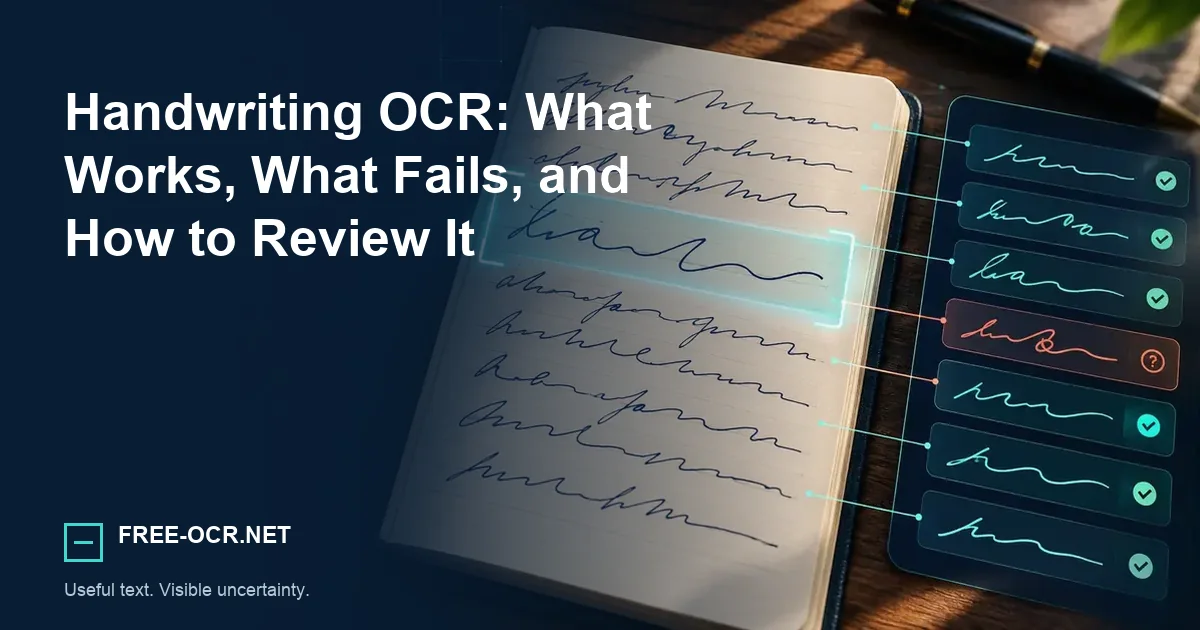
Learn where handwriting OCR works, why cursive and forms remain difficult, and how to review handwritten text without false confidence.
Use handwriting OCR as a draft
Handwriting OCR can speed up discovery and first-pass transcription, but every ambiguous name, number, date, and connected stroke still needs comparison with the source.
Why handwriting is different
Printed type repeats stable shapes. Handwriting changes by writer, speed, pen, line position, and neighboring letters. Cursive also removes the clean gaps that help a layout engine decide where one character ends.
Variation comes from several places
- The same writer changes shape with speed and fatigue.
- Pen width and paper texture merge or break strokes.
- Neighboring letters alter where one character appears to end.
- Corrections, margins, and ruled lines complicate segmentation.
What tends to work
Neat block letters, dark ink, ruled lines, consistent spacing, and forms with one value per field are the strongest candidates. Short isolated notes may be harder because language context has less material to resolve ambiguity.
Capture
Use even light, a square angle, and enough resolution to show separate pen strokes.
Writing
Block letters, consistent spacing, and one value per field provide clearer boundaries.
Context
Longer passages may provide more language context than an isolated surname or code.
For a non-consequential first draft, start with the Image to Text OCR tool and keep the source beside the output.
Failure patterns to expect
Names, abbreviations, crossed-out words, marginal notes, checkboxes, superscripts, and overlapping strokes need careful review. Never assume a plausible-looking word is the one the writer intended.
Identity risk
Names and initials can look plausible after a wrong prediction, especially without a reference list.
Numeric risk
Dates, quantities, decimal marks, and personal forms of 1 and 7 need direct checking.
Layout risk
Marginal notes, arrows, checkboxes, and crossed-out text may be read in the wrong sequence.
Context risk
An engine may prefer a familiar word over the unusual word that the writer actually used.
A safer workflow
Keep the source beside the OCR output. Correct uncertain spans rather than rewriting from memory. For consequential records, use a second reviewer or double-entry verification and retain the original image as the authority.
Keep both views open
Compare the source and OCR result line by line.
Mark uncertainty
Preserve an uncertain span instead of silently guessing from memory.
Escalate consequential text
Use a second reviewer or double entry when errors could change a record or decision.
Retain the source
The original image remains the authority after corrections.
Use the OCR versus manual transcription guide to decide when ambiguity requires a person.
Method and sources
The recommendations are limited to capture and review practices for handwritten material. They do not claim that cursive, names, or ambiguous personal letterforms can be certified automatically. Reproduce the technical behavior with the documented Free-OCR.net OCR methodology.