
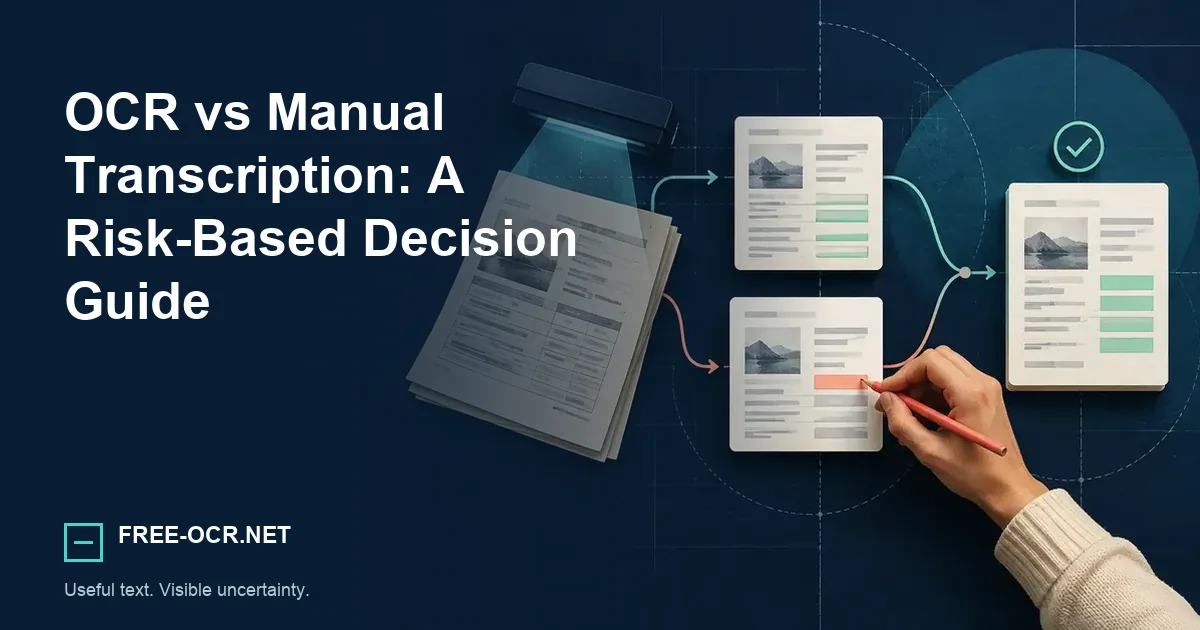
Choose OCR, manual transcription, or a hybrid workflow based on document quality, volume, structure, and the cost of errors.
Match the method to the risk
Use OCR for speed across legible, repetitive material. Use people for ambiguity and consequence. Combine both when volume is high but important fields still need verification.
Use OCR for scale
OCR is well suited to discovery, indexing, draft transcription, and repetitive printed forms. It gives people a starting point and can highlight low-confidence regions.
- Search and discovery across many pages
- Draft transcription of clean printed text
- Repetitive forms with stable layouts
- Prioritizing uncertain regions for review
Use manual work for ambiguity
Dense handwriting, damaged originals, mixed languages, unusual typography, and semantic judgments often need human transcription. A person can use context and recognize when the source itself is uncertain.
People add context
A reviewer can recognize that a source is genuinely ambiguous, consult surrounding records, interpret corrections, and avoid turning a guess into a clean but false statement.
Personal letterforms and cursive require the stricter review process in the handwriting OCR limitations guide.
The hybrid pattern
Run OCR, route low-confidence or high-risk fields to review, compare critical data against the source, and record corrections. This concentrates attention where it creates value without pretending the engine is infallible.
OCR-led
Best for readable material at scale. People inspect exceptions and decision-driving fields.
Human-led
Best for ambiguous, damaged, handwritten, or high-consequence records.
Hybrid
OCR creates the first pass. Rules route uncertainty and risk to an accountable reviewer.
- Run recognition on a representative sample.
- Define fields that always require human checking.
- Route weak or structurally uncertain output to review.
- Record corrections and retain the source.
Use the OCR tool directory to choose an automated first pass that matches the source format.
Measure the right outcome
Character accuracy alone may hide dangerous field errors. Measure whether the workflow correctly captures the facts that drive decisions, plus review time and unresolved uncertainty.
Field correctness
Did the workflow capture the facts that drive a decision?
Review effort
How much human time was needed to reach an acceptable result?
Open uncertainty
Which spans remain unreadable or disputed after review?
The confidence-score guide can help route uncertain text to review without replacing human judgment.
Method and sources
This decision guide compares workflow strengths by ambiguity, volume, structure, and consequence. It does not invent a universal break-even point or claim that either method is always more accurate. Reproduce the technical behavior with the documented Free-OCR.net OCR methodology.