
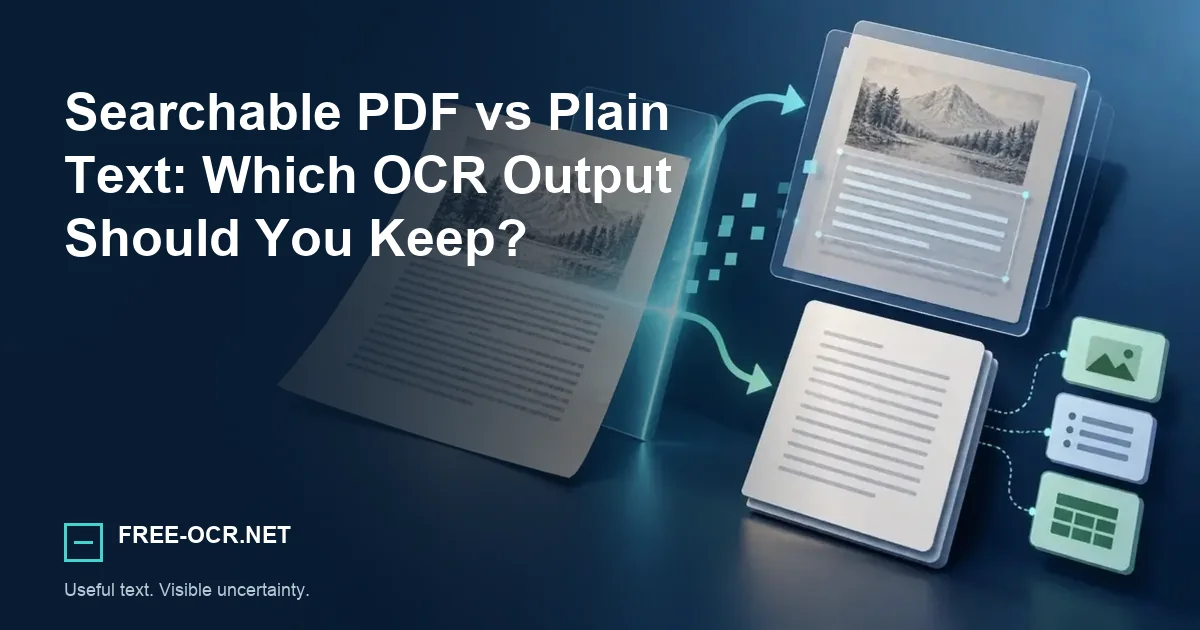
Compare searchable PDF, plain text, Markdown, CSV, and JSON OCR outputs by layout, accessibility, reuse, and audit needs.
Choose the output for the next job
Keep a searchable PDF when page appearance and source reference matter. Choose text, Markdown, CSV, or JSON when reuse, editing, or structured processing matters more.
Ask one question first
Will the next person need to see the original page, read clean text, or process fields and positions?
Searchable PDF
A searchable PDF keeps the original page image and overlays a text layer. It is useful when visual fidelity, citation by page, or comparison with the source matters. A bad reading order can still frustrate screen readers and copying.
- Keeps: the scanned page, visual context, and page references.
- Adds: an OCR text layer for search, selection, and copying.
- Still needs review: reading order, text-layer accuracy, and accessibility tags.
The current scanned PDF to text tool exports text and diagnostics; it does not generate a searchable PDF.
Plain text and Markdown
Plain text is durable and easy to search, diff, and import. Markdown adds lightweight headings, lists, and tables when those structures are reconstructed deliberately. Neither format preserves exact page appearance.
Plain text
Best when portability, search, diffing, and simple import matter more than visible hierarchy.
Markdown
Adds lightweight headings, lists, links, and tables when a person or process reconstructs them deliberately.
When assistive use matters, also review OCR reading order and accessibility.
CSV and JSON
CSV works for genuinely tabular rows but cannot naturally represent nested sections or multiple coordinate boxes. JSON is better for automation because it can retain pages, confidence, line order, and metadata.
Do not confuse a container with validation
A CSV file does not prove that rows were detected correctly, and JSON does not prove that a field label was assigned to the right value. Validate structure against the page.
Keep the source
OCR output is derivative evidence. When records matter, keep an unaltered source, record the conversion method and date, and store corrections separately rather than silently replacing the original.
| Output | Best use | Preserves page appearance | Supports structured automation |
|---|---|---|---|
| Searchable PDF | Visual reference, page citation, and archive access | Yes | Limited |
| Plain text | Reading, searching, and simple reuse | No | Basic |
| Markdown | Readable lightweight structure | No | Moderate |
| CSV | Validated rows and columns | No | Strong for flat tables |
| JSON | Pages, positions, confidence, and nested records | No | Strong |
A durable pair
For records with long-term value, retain the unaltered source beside a reusable export and keep corrections as a separate, traceable layer.
Method and sources
The comparison evaluates what each output preserves for search, reuse, structure, and source review. The current Free-OCR.net tool exports text and diagnostics; it does not claim to generate a searchable PDF. Reproduce the technical behavior with the documented Free-OCR.net OCR methodology.
- Tesseract OCR documentationExamples of plain text, hOCR coordinates, and searchable PDF output.